Analysis: Part of a new law to legalize more apartment homes in commercial zones, Washington State has reduced mandates for ground-floor commercial space in new apartment buildings.
By Dan Bertolet
Published April 2, 2026
This article was originally published by Sightline Institute.
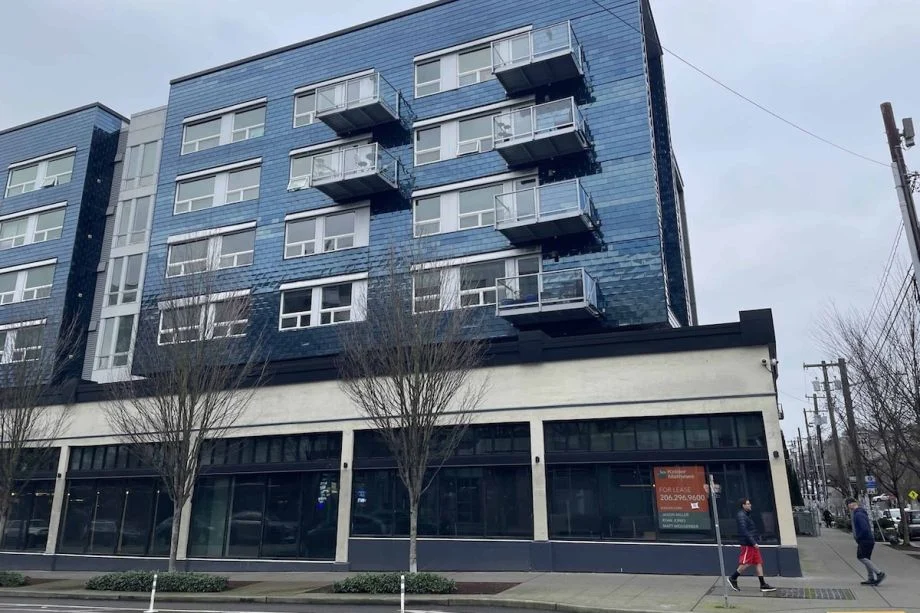
If you travel through pretty much any city in the United States, it’s hard not to notice abandoned strip malls, vacant big box stores, and empty storefronts on downtown streets. It’s the result of massive changes over the last couple of decades in how people shop and where they work, colliding with outdated zoning rules that mandate too much commercial-only zoning.
Several states have passed laws to fix these rules, a great first step in reviving local economies while also building the homes people need. And Washington state just took it one step further—the first in the U.S. to do so. A new law passed this session will not only allow homes in commercial zones; it will increase flexibility for builders on whether to include ground-floor commercial space in apartment buildings.
And while this latter point was the most contentious part of the bill as it wound its way through the halls of the state house, it’s a critical measure of flexibility for more home choices and fewer vacant storefronts—and why a powerful coalition stretching from the governor’s office to business associations, real estate groups to nonprofit housing developers, united to pass the bill.
Just as hundreds of jurisdictions have been doing away with wasteful parking mandates, letting owners decide the amount of parking that will help their project succeed, SB 6026 will let apartment builders decide whether ground-floor retail makes sense. Where it does, great. Where it doesn’t, no longer will rigid requirements stop housing from getting built at all by making it impossible to finance. And the bonus is that ground-floor space can be used for more homes.
All told, Governor Request Bill SB 6026, sponsored by Senator Emily Alvarado (D-Seattle), is another notch in Washington’s belt of U.S.-leading pro-homes legislation, a list that includes accessory dwellings, middle housing, apartments near transit, co-living, lot splitting, and single-stair reforms. By allowing apartment homes to rent or own near businesses and shopping districts, and by granting flexibility on ground-floor retail, SB 6026 will help create more affordable and convenient home choices for Washingtonians, and more foot traffic for local businesses.
Fewer dark windows, more neighbors. Here’s how it happened.
The problem: Too much unused commercial space and not enough homes
Washington state has a shortage of homes, not a shortage of retail or office space. E-commerce began decimating brick-and-mortar retail in the early 2010s, and then the COVID-19 pandemic catalyzed a massive shift to work-from-home. As a result, most Washington communities now have a glut of underutilized commercial buildings, albeit with localized exceptions.1
But all too often, zoning laws prohibit homebuilding where offices and stores sit vacant. That, in a nutshell, is the reason for SB 6026. It will end the exclusion of new homes from areas previously restricted to only retail, office, and other non-residential uses. Because it makes no sense to set aside scarce urban land for things we already have too much of, while keeping it off-limits to something we desperately need: more homes.
Furthermore, the new law won’t ban commercial projects but rather give builders flexibility to make their own choices about what to construct. If a particular location has strong demand, builders will still be free to build space for shops and offices instead of housing.
The stakes: Mandating ground-floor retail can make the housing crisis worse
This part of SB 6026 warrants more ink. Cities commonly require developers to include ground-floor commercial space in mixed-use apartment buildings. It’s a decades-old, well-intended policy designed to create attractive, walkable centers with bustling street life and businesses.
But a big problem with these rules is that in most cases today, street-level retail spaces cannot generate enough rental income to cover the cost of their own construction and operation. That is, they are money losers for mixed-use projects. And it follows that mandating them makes it harder for builders to finance apartment developments, which means fewer homes get built and the housing crisis gets worse.
Just like with any rule that inflicts an additional financial burden on homebuilding, when a city mandates ground-floor commercial, what it’s also mandating is that, over the long term, renters and first-time home buyers will have to shell out more for their homes. In effect, it’s a forced subsidy everyone pays to support non-viable commercial spaces.
And it’s regressive. A growing body of research confirms that adding new homes helps keep rents lower, even at the low end of the market. And conversely, the book Homelessness is a Housing Problem documents how in places where housing is scarce, homelessness rates are higher. Connecting the dots, the tradeoff policymakers should be weighing is, how many people are we willing to put out on the street to make sure every building on Main Street is lined with street-facing retail that often sits empty anyway?
So far a few U.S. cities have addressed that tradeoff by relaxing their ground-floor commercial requirements. Meanwhile, here in Washington, SB 6026’s provision to do the same drew heavy opposition from cities (more on that below). That’s the tell, though: if city officials think ground-floor retail won’t get built unless they mandate it, it confirms they know it’s a regulatory burden—unfortunately, one that will manifest in higher rents across the board that most harm those who can least afford it.2
Here again, SB 6026 will not ban anything. Developers can still put shops in their buildings if they want to. But the critical ingredient for pedestrian-oriented businesses is having enough patrons living nearby. And the gotcha is that mandates for ground-floor shops backfire by thwarting the new homes those patrons would live in and help make those shops viable in the first place.
What about the risk that a neighborhood could fill up with so much housing there isn’t enough retail space to meet demand? In that case, people will find ways to convert housing to shops, as they have for centuries before zoning existed, and continue to do today to create some of the most charming neighborhoods in North America.
The win: SB 6026 unlocks tens of thousands more parcels to apartment homes
The office of Washington Lieutenant Governor Denny Heck studied the potential of legalizing housing in commercial zones, concluding that it’s a “high-value, high-impact opportunity in many communities while increasing public revenue and avoiding some tougher tradeoffs on greenspace or existing homes.”
The Puget Sound Regional Council hired HR&A Advisors to assess SB 6026, who found that of the total 71,000 commercial parcels, 75% of parcels “face significant hurdles to residential development,” and of those, about 9% would be large enough financially feasible to develop. It’s a rough estimate but suggests big potential for new housing.
Sightline mined the Washington State Zoning Atlas to evaluate current allowances for multifamily housing and assess the potential for SB 6026 to expand those allowances statewide. Here are key takeaways from the data table below:
- 52% of land zoned for office or retail either prohibits housing or limits it through conditional, limited, or accessory use restrictions. One-third of land zoned for office or retail prohibits housing entirely.
- The 113,820 acres zoned for office or retail that prohibits or limits housing is equivalent to 62% of the 183,776 acres zoned for multifamily. In other words, legalizing housing outright in those commercial zones could increase land available for multifamily statewide by up to 62%.
- Mixed-use zones make up 45% of the total land that allows either multifamily or mixed-use housing. In other words, on 45% of the land where apartments are allowed, ground-floor commercial uses may be required.
On paper, the capacity for new homes created by SB 6026 is ginormous—several million, assuming four-story apartment buildings materialized on all of the office and retail land that currently bans housing. That’s in the same ballpark as an early estimate of the raw capacity for housing created by Washington’s 2025 TOD bill.
Of course, in the real world, layer upon layer of limitations vastly reduces the viable pool of land. For SB 6026, HR&A estimated 5,249 parcels at least an acre in size could be feasible to redevelop into housing. Back of the envelope: for four-story apartment buildings that’s at least 800,000 homes.
Understanding cities’ pushback: Tax base, bustling downtowns
The part of SB 6026 that allows housing in commercial zones moved through the legislative process largely unscathed, with a few minor carve-outs. In contrast, SB 6026’s ground-floor retail flexibility component was substantially weakened after an onslaught of pushback from local governments. Cities that testified in opposition to this part of the bill included Bellevue, Bothell, Kent, Kirkland, Lacey, Lakewood, Pasco, Redmond, and Renton, as well as the Association of Washington Cities.
Two common threads of concern: it would undermine long-standing efforts to create attractive, walkable retail centers, and it would threaten tax revenue (see here and here for analyses that contradict the tax claim). Redmond’s planning director noted in her testimony that rapid redevelopment has been eliminating retail space in the city and creating a shortage.
Bothell mayor Mason Thompson, known for his strong pro-housing leadership, argued that builders are unlikely to put housing on the ground floor and downtown streetscapes will end up deadened with parking and blank walls. It’s a good reminder that competing priorities play out differently in different cities and towns—even as our deficit of housing choices remains a constant.
The compromise: Leeway and local control
The bill, as introduced by Senator Alvarado, would have made ground-floor commercial optional in all multifamily projects everywhere, except under a handful of special conditions. Advocates successfully protected that full flexibility for all subsidized affordable housing projects. For market-rate projects, however, legislators amended in several exclusions and limits.
The most consequential targeted exclusion is transit station areas, as defined by Washington state’s 2025 TOD bill (half-mile radius for rail stops and quarter-mile for bus rapid transit). Of the total land to which the original bill applied (see table above), TOD areas account for 9% of land that allows office or retail, and 16% of land that allow mixed-use. Neighborhoods around stations are logical targets for creating walkable, mixed-use centers, though even there, excessive ground-floor mandates could do more harm than good (more on that below).
But the biggest hit to the bill’s overall impact came in amendments allowing cities to retain ground-floor commercial mandates on a set portion of their land. The bill as passed out of the Senate had a 20% allowance, later raised to 40% by the House Local Government Committee, which also eliminated some of the targeted exemptions in an effort to balance flexibility with local control. The final bill kept a Senate provision intended to incentivize upzones that will let cities require ground-floor commercial if the zoning allows heights of at least 85 feet (typically eight stories).
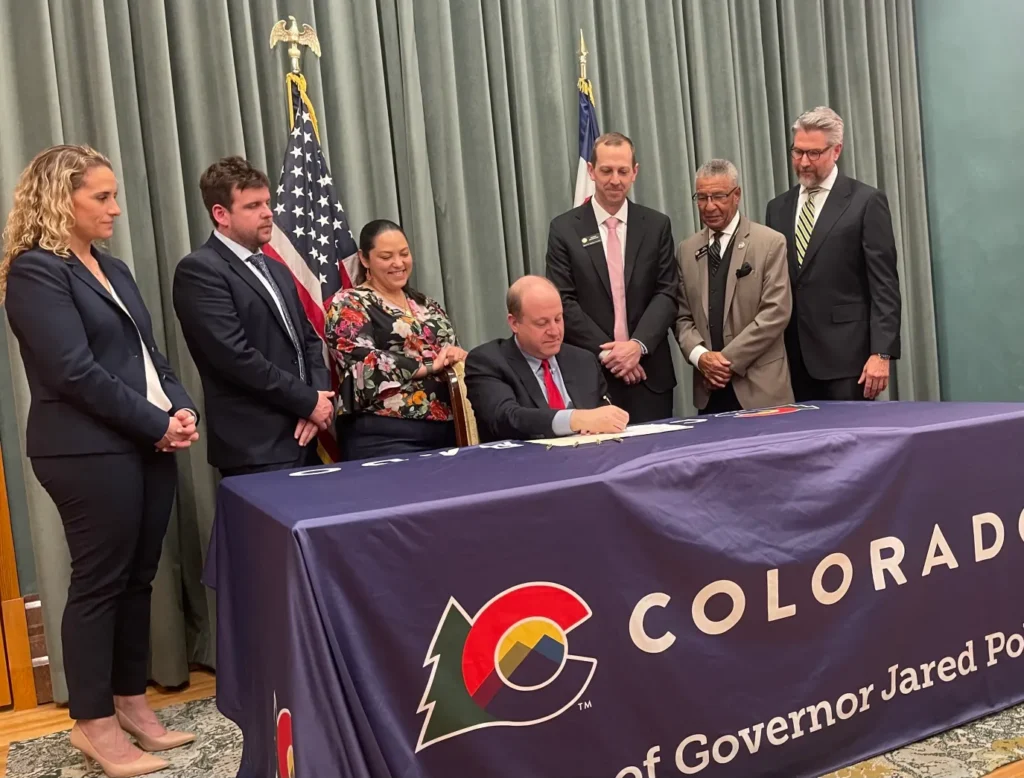
In its last public hearing, most testifiers on both sides of the debate registered as “other”—because it’s a sign of a good compromise when no one is happy. Right? But joking aside, concessions and all, getting the homes Washingtonians need proved to be a unifier. A formidable coalition lined up behind SB 6026: in addition to being a priority for Governor Ferguson and Lieutenant Governor Heck, the bill was spearheaded by former Governor Christine Gregoire’s Challenge Seattle and had a stamp of approval from builders, real estate, and business groups, as well as support from Futurewise, Sightline Institute, and the Housing Development Consortium.
After amending in a last minor exception, the House passed SB 6026 on a bipartisan 69–27 vote. Next stop, the Governor’s desk, which should be a layup given that the bill is Governor’s request legislation.
The path ahead: Viability, variation, visibility
Some thoughts and speculation on SB 6026’s allowance for housing in commercial zones:
- While there may be plenty of spent buildings lying vacant in strip malls, whether it would be viable to redevelop them into apartment buildings is a different question. They are often located on busy arterials or in giant parking lots that are unpleasant to live near, which means lower rents and lower likelihood that a project will pencil. That said, it’s still good policy to make these options legal, so that if a builder can make a site work, they don’t get shut down by obsolete zoning barriers.
- Retail zoning is typically designed for buildings shorter than apartments, but the bill doesn’t require any change in allowed height, so housing development may depend on cities first taking additional action to upzone.
- The bill’s language stating that local governments are “prohibited from excluding residential uses in areas zoned for commercial or mixed-use development” may leave the door open for cities to block housing with conditional use rules or similar limitations that don’t explicitly prohibit housing. A typical conditional use permit inflicts extra process, delay, and risk that can be almost as effective as an outright ban.
And on SB 6026’s rollback of ground-floor commercial mandates:
- Subsidized affordable housing is a clear winner. Not having to include ground-floor commercial will make projects easier to finance and give affordable developers a leg up on for-profit developers when competing for land to build on.
- SB 6026’s impact on the future prevalence of ground-floor commercial mandates will vary between jurisdictions. Smaller cities tend to have a lot less mixed-used land than commercial land. For those cities, because the exemption is 40% of mixed-use plus commercial, it should be easy for cities to retain ground-floor requirements in all of their existing mixed-use zones and stay below the 40% cap. Seattle, on the other hand, has a relatively large amount of mixed-use zoning, so the 40% cap will likely require removal of some existing mandates.
- The bill’s exclusion of TOD areas from ground-floor commercial flexibility reflects a common recognition that it’s important to have shops and services near transit stops. But concentrating a development-hindering requirement in the very place where we most want more housing could backfire by pushing development elsewhere. To kickstart TOD, it may be better to get a new apartment building, even if it doesn’t have ground-floor retail, than to get nothing new at all.
- Even if the letter of the new law doesn’t end up forcing a sea change on ground-floor commercial in many cities, the legislation has ignited an important new conversation. Cities throughout Washington state are likely to revisit and reassess their rules, while other states or provinces may be inspired to copy—and hopefully improve on—Washington’s bill.